Showing posts with label WWI French. Show all posts

Sunday, 30 July 2017

Chasseur à Pied Completed.

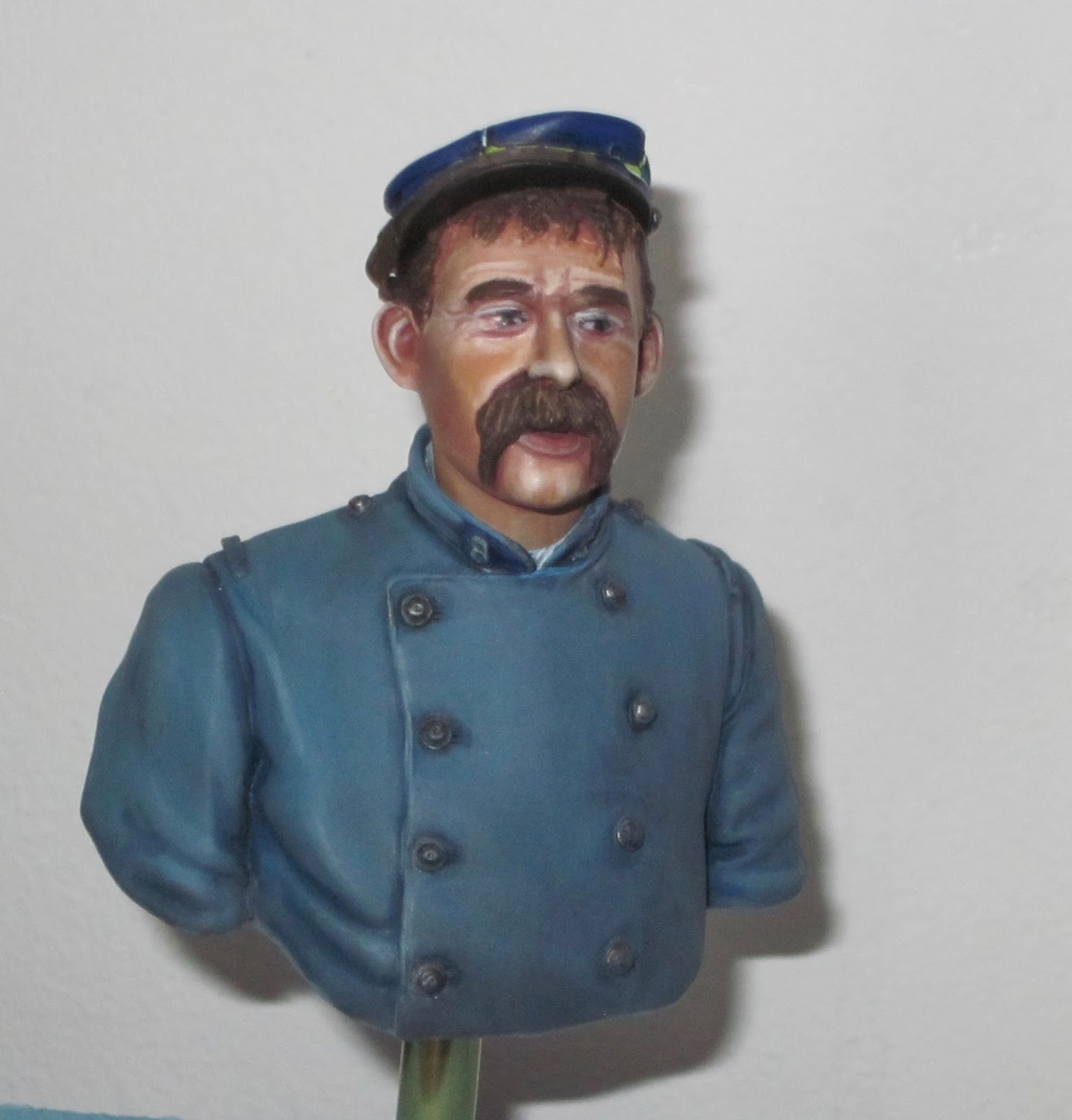
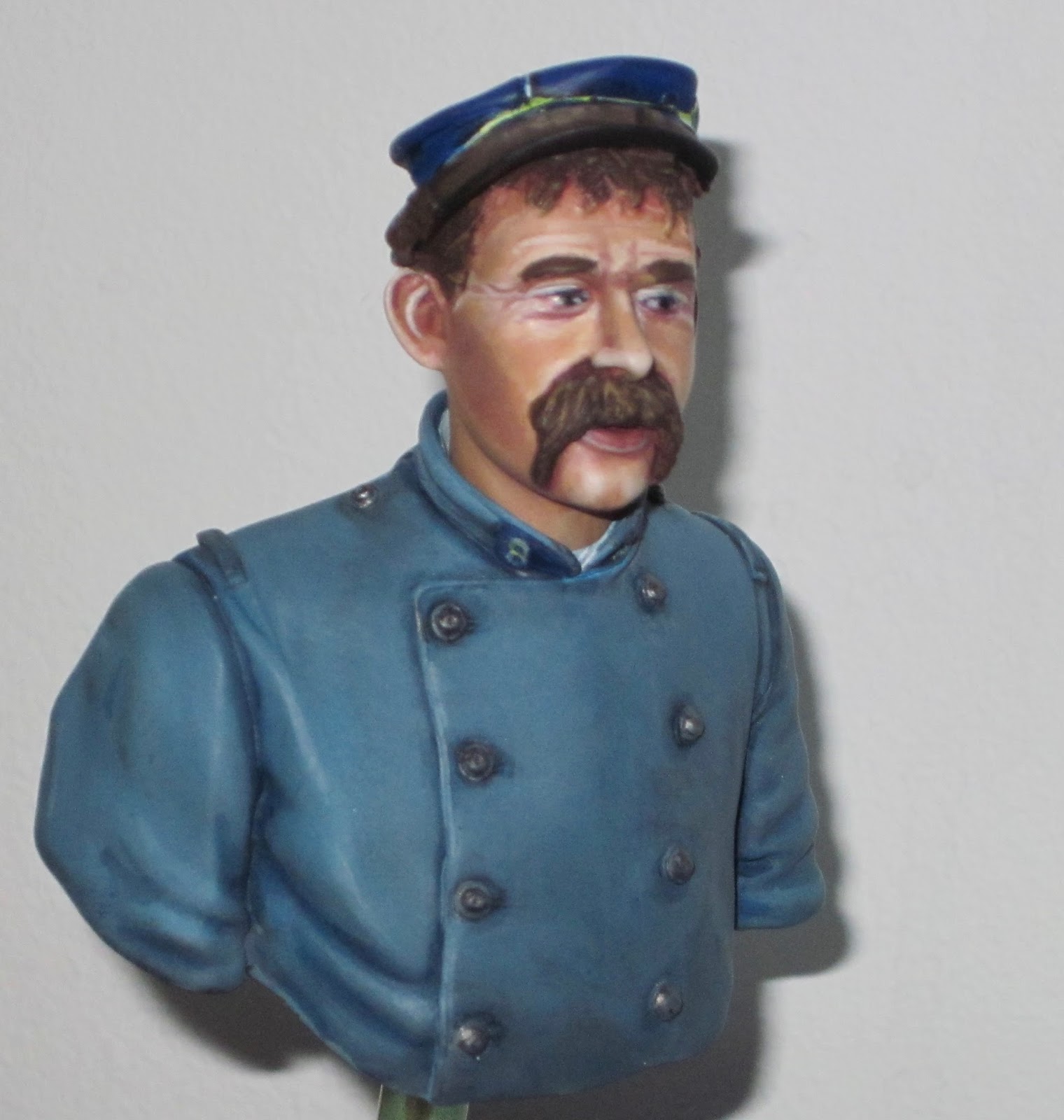
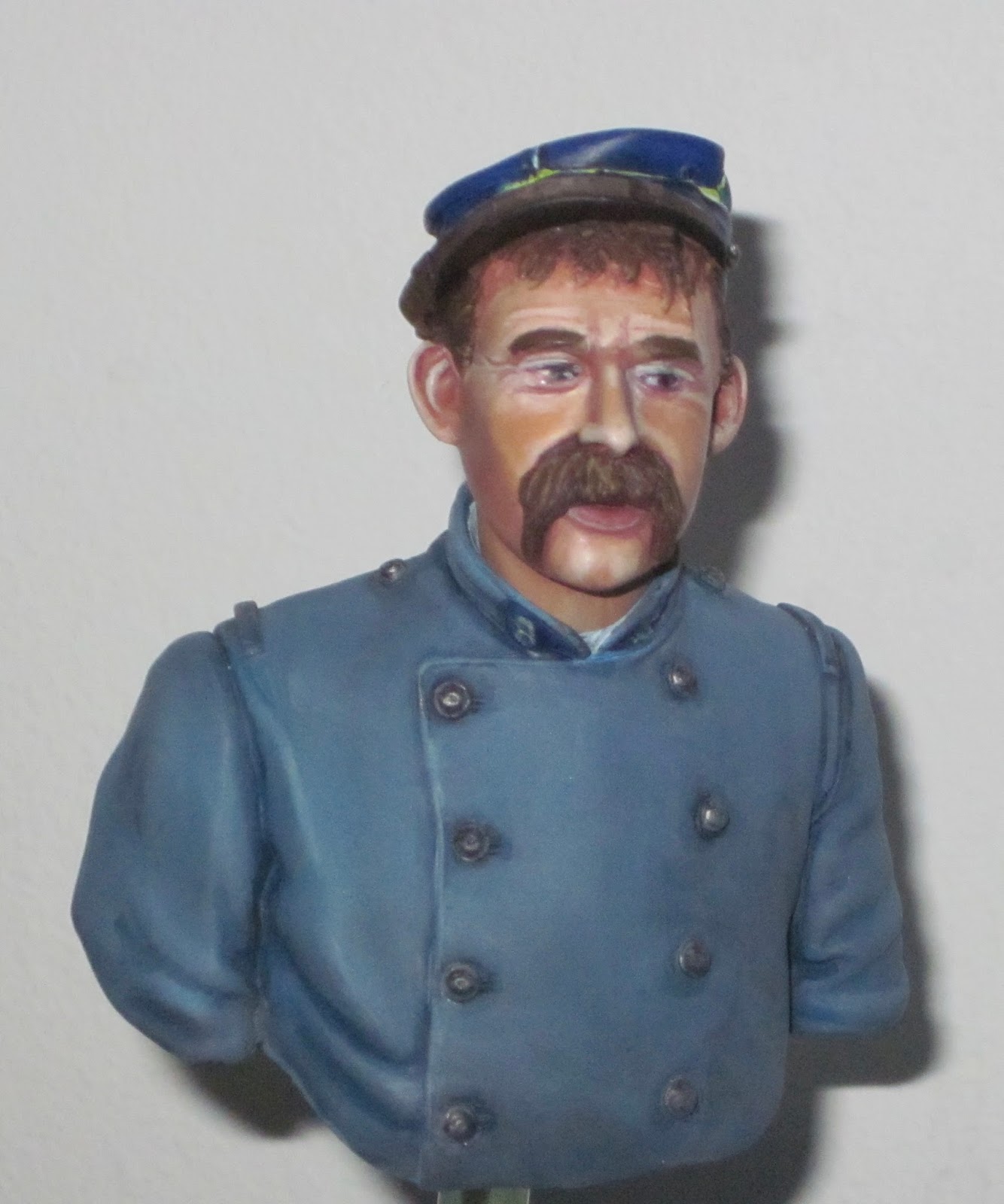
Well here is my completed Chasseur à pied. He is depicted  has the  Jon Smith Modellbau instructions suggest waiting an early version  of the horizon blue greatcoat.  I did contemplate  painting it French blue as per the early pattern greatcoat. In the end I opted to go with the horizon blue option because it offers a contract to the kepi.


The horizon blue was mixed in with grey, black, French blue and Prussian blue was mixed in varying amounts to represent dirt and grime engrained into the greatcoat.  The buttons  where painted  in U.S. grey and then high-lighted with pencil lead.  I feel the general look of the uniform is a bit too Confederate grey. I will come back to it later see if it blue is glaze would help it.


The kepi got the French blue treatment with shadow layered with a  touch of black. the piping was  painted with lemon yellow and then highland with pale sand with a touch of sand mixed in. Lots of patience and a fine rigger brush.  Knowing when to stop was a key in painting the piping.


Thanks for taking the time to look at this post I do hope you like the almost finished result. Please feel free to add your comments below.


Saturday, 4 March 2017

Moustache for a Chasseur à Pied

I just spent the last two and a half hours painting a moustache. I think I should leave it alone now so's not to bugger it up.  To be fair, I also added the eyebrows and worked the hair also.   All in all a productive afternoon.


The colours used were German Camo Black Brown (70822) for the shadow,  Chocolate Brown (70872) for the  mid tones  and an orange mix with  Fire Red (71084) and Lemon Yellow (70952)   

Next job is the kepi.


Wednesday, 22 February 2017

Chasseur à Pied

This is the first effort at painting a bust. So it is a learning exercise. Over recent years I have grown keen on French Army Uniforms of the early part of the First World War.  I’ve had my eye on this Jon Smithmodellbau bust of a Chasseurs à pied for some time so decided to take the plunge.


Having never painted a bust before I referenced a couple of articles from Military Modelling August and September 2016 issues where Fernando Ruiz wrote up Jaume Ortiz’s technique for dealing with busts . What appealed to me as a beginner was the simplicity of the technique.  He uses only three colours to get the flesh tones. A sand brown (70.876) as the base coat and light flesh (70.928) for the highlights and finally a black red (70.859) to create the shadow.


After the undercoat was put down in around six thin layers I added in some of the light flesh in to the mix and started with the first highlight. Then once  that was dried I added a second  highlight before  moving on to block out the shadow  on a  mix of the  sand brown  base layer  and  a the red brown.


 From here I built up the different levels of shadow and light on the face with the appropriate mixes until I was happy with the balance. Following that I watered-down the paints further now between the consistency of milk and water in an attempt to blend together the different areas.  Currently this process   needs a bit more refining it looks a bit like badly applied foundation at the moment!


Most of a afternoon was spent on trying to get the eyes right. After having various misadventures with bleeds of different coloured pain and a disaster with gloss varnish I have reached the uneasy compromise of eyes which are all most there.


  I would love to hear any thoughts, tips or critics of this project so far.       

Friday, 14 October 2016

Battle of Guise (Again)

This week at the Central London Wargames Club we got an opportunity to have another go at the fighting the French counter attack on the left flank  of the battle of Guise. 

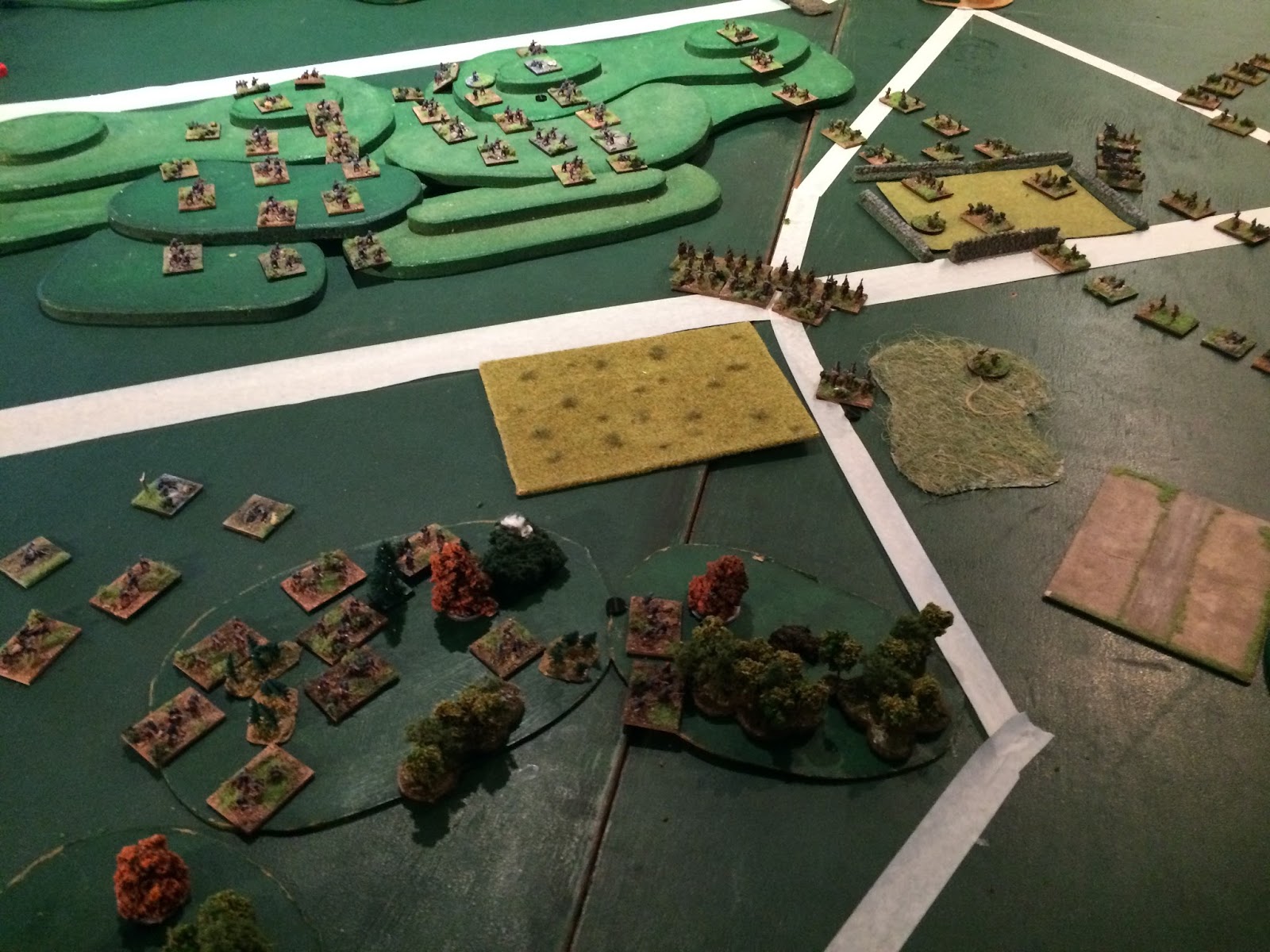
The French advancing, note in the background a unit of Uhlans charging down the road towards the French rear.
It transpired to be a most successful scenario which seemed to represent the historic action well.  Though the French came out slightly better at the end of the day. This was principally because the Germans ran out of steam by the closing stages of the engagement. 

The Germans, under Martin's command showed his Ulan's agility by galloping  the entire length of the  board to take up positions  in the undefended town in the French rear. 


Two regiments of the French centre traverse the high ground . 
In doing so  they successfully avoided my French cavalry who were scouting against him  they had just barrelled up the main road in an effort to take the crossroads. They got a nasty shock has they met a regiment of Artillery sitting on the crossroads. Unperturbed they charged! The follow action perturbed them somewhat but not before destroying a battery of  German 77's. This forced the Germans to show their hand and allowed the French to zero in on the crossroads.

The main French advance was on three fronts, sending the main force of 2 regiments over the central hilly region. They were supported by a the third Regiment and a Regiment of 75mm Artillery  to their right who where principally positioned to to defend the road and cover the flank of the main thrust.  


The French right flank in position  to engage the advancing Jaeger regiment.
On the left of the main attack the French attempted to flank the German advance with a regiment of Tirailleurs Senegalais light infantry. 

The centre commanded  by Alan, held  the advancing Germans and they fought  each other to a stalemate with a regiment from each side  forced in to retreat due to excessive casualties. On the left the Tirailleurs failed to cross the canal and were met from strong German defensive fire from the village.

However on the right flank the French 75's fired effectively causing casualties to the remaining German Regiment allowing the third  French regiment to advance  and flank the German positions which would force them into a withdrawal. 


We have played a  good few historical refights of First World War battles over the centenary period using the Great War Spearhead rules and it seems to work well and produce generally  historical results as far as we can tell. Though personally I find elements of the rule set quite complex when it comes to artillery fire. Despite this the rules seem to produce entertaining evening of gaming.  

Monday, 27 June 2016

Battle of Guise


In May over the Spring Bank Holiday which happened to coincided with the centenary commemorations in France and Germany of the Battle of Verdun. We got together at Central London Wargames Club  to play a Great War Spearhead game. The scenario was based around a French counter attack on the 29th August 1914 during the closing stages of the battle of Guise. At this stage of the battle the French attacked in an attempt to turn the German flank and cause a withdrawal in their centre.


Using the online trench map archives at the library in McMaster University I located the area on a contemporary War Department Map. Which meant we could approximate the terrain on the table top. The scenario involves the French assault on the German Flank in an effort to turn it and force them to break off their offensive. 


I was the French. My tactics left a bit to be desired. I forget field artillery had the ability to fire indirectly. To add to this I insisted on driving them through a wood which is never a good idea! 

As a result my infantry attacked with no support. And suffered horrendous casualties. 


We did manage a cavalry charge engagement as the two scouting elements found one and other in the centre. Again poor situational awareness was my undoing. My cavalry strayed too close to a German machine gun position which wasted no time pinning one of my cavalry stands resulting in  being out numbered for the charge. Still if was interesting to get into the position for a cavalry charge in the first instance although my cavalry were beaten and withdrew. 


On reflection if we fight the battle again I would be a bit more cautious and attempt to orchestrate the assault more closely with the artillery and shell enemy through out the advance. In an effort to get more pin markers  on the Germans which would give the French a better chance of breaking through their line. However the outcome was basically historical.  


Should we fight the battle again we will see if I've learn't anything. 


Friday, 27 May 2016

Tirailleurs Sénégalais


I am happy to report more progress has been made on additional units for my early First World War armies. The latest unit to arrive are French colonial light infantry. 


So far I have enough stands for around a regiment and a half. So I reckon they can make up a handy reserve force. I'd suggest that they would fit into a division or corps organisational table for the period.


These figures turned out very nicely I am pleased with the way they have painted up.  There is a colour picture in Hew Strachen’s tome The First World War which depicts Tirailleurs Sénégalais in white putties. It was dated 1913. So I opted to add the putties using light grey.   They'll make an interesting addition to the French side that originally peaked my interest in the early war period because of their colourful uniforms. 


The next on my painting table is German jägers which offer a little variation to the skirmish lines of field grey and pickelhaubes.