Well, with a minimal fanfare of
trumpets, the clatter of pots and pans and the sound of hobnails on cobbles I
can finally announce I have completed painting my Early Imperial Roman
Army.


At this point it is worth while doing a little recap of the
main elements that make it up:
We have three legions of legionnaires making up the main
force. These legions are made up of six bases apiece but obviously could be
configured in to more flexible four base battle groups.

Supporting the legions are two battle groups
of Roman Auxiliary who are classified as medium foot. They can fulfil a
number of roles in addition to dealing with broken ground but also they
can offer rear support.

In addition to the Roman Auxiliary I have included some archers
units despite never having used before. Nevertheless, I have given
myself some extra options including using them on high ground or
interspersed in a line to fire and withdraw.


Rocking up behind the Auxiliaries are the noble
Roman Cavalry who in my experience die quite easily no doubt due to my
own poor handling. However I have promised myself not to squander the
lives of the sons of Roman by charging it to all and sundry.


Next up are the light elements which comprise of a load
of blokes who throw a load of rocks at the oncoming enemy and
then get out of the way just in time for the next battle group of Equites
Satgitti to sweep in and unleshing a volley of arrows before charging off
on a heroic flanking mission of some description.


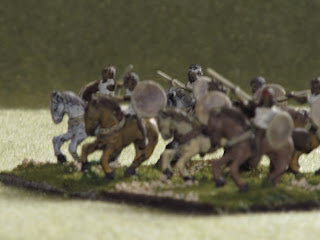
On to the one of my favourite units the Numidian Light Horse
who can case no end of mayhem to the enemy ranks by racing up and throwing pointy sticks at them.

The final battle group is the light bolt shooters
who can sit on an hill getting drunk waiting for anyone to stray into
their field off fire and then they can unleash a couple of larger pointy sticks
at them before getting back their picnic.


One must not for get the illustrious command stands whose
job it is to lead this army around the fields of felt and over the plywood
hills to Elysium.


