Friday, 25 January 2013

Ironclads in the Adriatic


A couple of weeks ago I had the opportunity to have a game of  "Ironclads in Action" with Alan and some of the guys at Central London Wargames Club.
We played a fictitious scenario of an engagement between a British Fleet coming up against an Austro-Hungarian fleet in the Adriatic Sea during the latter part of the nineteenth century.


Alan has devised a cleaver way of depicting the ocean. He lays out a 6x10 foot wide length of blue light weight fabric. Over the top of which he places a sheet of clear cellophane  which can cover the entire surface area of the 6x8 game table with on overlap of a  foot or so on either end.  Finally a 2nd clear sheet is placed over the table on the opposite orientation with the overhang cellophane length ways rather than long ways.

With ironclads the action tends to gravitate to the edge of the playing area. However because of Alan's cleaver system if the action heads for the edge of the world  all that is necessary to do is to pull the cellophane one direction or another to centre the action. This allow the scale distances  to be maintained easily in a what is a true scale game.


Our game consisted of three players on each side. For the Austro-Hungarian Howard, Jesse and I for some reason beyond my comprehension selected me to fulfil the role of admiral

In any case we started off very well, sailing our ironclads and line abreast at the Royal Navy fleet sailing up the middle of the table. Howard's Squadron was the first to encounter the British fleet and got embroiled in a slugging match at closing distances. This caused the British line to concertina and slow allowing my squadron to interpenetrate the line and offered the opportunity for me to ram one of the British ships. Unfortunately I missed but managed to get ships entangled.


This is where things started to go wrong for me.  The next round second ship in my battle line had the ingenious idea of firing at the British vessel which was entangled with my flagship. Predictably enough I missed the target and there was a thirty per cent chance of the shot hitting my own ship. Predictably enough I rolled a 30.  To add insult to injury Howard who was firing on the same target also missed his mark but was successful in causing another hit to the Austro-Hungarian flagship.


At this point we ran out of time and we all agreed that the game should be called a draw before I sank one of my own vessels!

Photo credits: Alan 

Friday, 18 January 2013

A Further Sherman Update

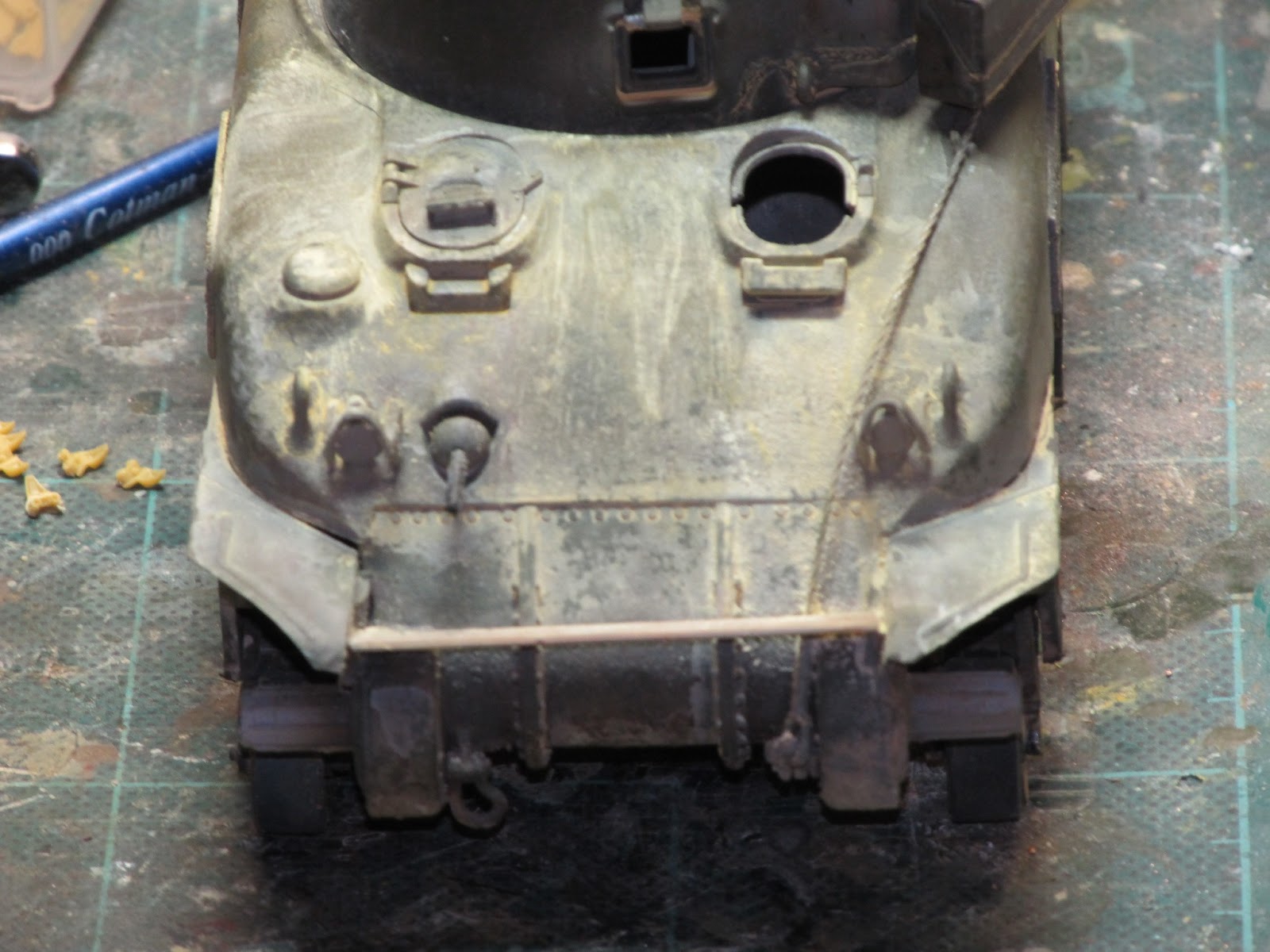
I have been plodding along at a snails pace with my North Irish Horse Sherman project. Although progress is slow I am pleased with the outcome so far.  In the weeks building up to Christmas an added a couple more oil washes. These are to reflect grime and dirt.  This was followed by a heavy acrylic wash with sand represent large deposits of light dirt and dust over the super structure.  Before each of these stages it dappled contact points on the hull and turret with olive drab where the dirt was rubbed off through contact.


Naturally enough I have managed to knock off a number of bit in this process. Nevertheless, the next stage is to bring together all the individual elements.  The turret, hull, stowage and hatches etc and bring it all together with some beach sand pigment and take the opportunity to tidy up areas which need work.


Next up we will tackle the tracks. Yikes !!


Tuesday, 15 January 2013

A Long Overdue Post


This is a long overdue post. I took the opportunity to escape from Christmas and the associated revelry on Thursday evening, the (27th) for a couple of hours to the CLWC.


My Romans took on Alan's ancient British once again. While I lost the initiative and he opted for agricultural battlefield. It provided wide open spaces for my legions to get chased around by his army which mainly consisted of chariots.

In the end I set up the auxiliary, my light bolt shooters with my noble Roman cavalry on the right flank. The centre consisted of three legions with some rear support of auxilia archers. Because of the placement of a road bisecting the table about a third of the way in I didn't bother with anything on the left flank.


To be honest I am at a loss to provide a meaningful synopsis of what took place in the game because there was so much movement and charging around the table.  On the right I held my cavalry back which gave them the opportunity to charge at and catch a battle group of chariots between them and a battle group of Horse Archers. This battle group along with the Numbian Light Horse charged up the centre hurled a load of sticks at the British and ran away. At this point the Legions move foreword to engage the chariots. The resulting engagement resulted in me losing one legion. Nevertheless, I felt on balance if the game continued I would have prevailed in the centre.     


I am hopeful that the selection of photographs will illustrate the battle. Everything went more or less to plan. I marched up the centre with my legions headed up by my light horse in the centre. On the right flank I let him come on to me resulting in me chasing his light horse off the board. Thankfully for me at least I managed to get a couple of light    both shooters off to concern one of the battle group of Alan's chariots. By then time had run out so we called the game a draw although Alan was marginally ahead.

The Action ob the left flank

The legions plod forward towards the chariots

Progress on the right flank by the Roman cavalry 


The legions repel the first chariot charge and prepare for another attack
The cavalry and light horse charge a battle group of chariots


Wednesday, 19 December 2012

Romans Vs Ancient British

Last week my early Imperial Romans got a run out against Alan's Ancient British. This was the second time these two armies met. The first encounter was back in August and Alan won convincingly routing my army with some good use of his mobile army.

This time with the rematch he showed up with an even more mobile army comprising of chariots light horse and light foot. I won the initiative and opted for a developed battlefield. Placing down some enclosed fields and a village to break up the open ground which might favour battle groups of chariots to come hammering across causing mayhem.


The placement of terrain 


In the set up both Alan and I placed ambush markers on the gentle hill to my left. His was a fake but mine was real.  Once his light foot advanced they discovered an average legion waiting to get shot at. I needed to get the hill so he could not deploy his chariots on it providing them with a clear run down to my legions.  The obvious flaw in this was they where isolated. What was worse Alan’s light archers managed to disrupt my legion forcing them to charge and isolate themselves even further. Naturally, he evaded long and I charged normal so I failed to hit him in the back with my legion, resulting in even more isolated the legion on  right flank. This quickly degenerated into a foot race to support the legion before they got mullered. This I nearly achieved, nevertheless, the legion was soon dispatched in smart order by Alan's chariots.


Attempting to get support to the isolated legion 
On the left flank I took a similar gamble.  My cavalry was out numbered 3 - 1 by two bases of light horse and one of chariots. I needed to break the light horse and send them off the side of the base. And then with any luck I could draw the chariots on to my light bolt shooters. Again this whole plan depended on the luck of the dice since I expected Alan’s light horse to evade. I need to roll long in pursuit and have him roll short so I could charge him in the rear an hopefully route him off the table. Alias he rolled long and I rolled normal. Resulting in my cavalry isolated and in a spot of bother!!


In the background; my cavalry preparing to charge Alan's light horse 

This leaves me with a third loss out of three games in recent months. In fact, I suspect my legionnaires  might ask me to put them on ebay!!

Photo credits Alan
 

Sunday, 16 December 2012

Sherman Update

Tardiness would best sum up my attitude to blog writing over the last month or so. Nevertheless, you can read some of my recent blog contributions on pigeons I penned in a professional capacity. So let's take the opportunity to give you a quick update of my North Irish Horse Sherman. It this point it think the filter washes are more or less complete. They offer a nice mix of grim and dirt that has built up over time while in theatre.


Another reason for the long delay in progress was fear.  For the next stage I want to add quite heavy weathering with light shades of sand so -I am concerned about messing it up.

It terms of reference for the next stage I will use Mario Eens article on building and weathering a DAK Panzer I. From Military Modelling 
Issue 3 Volume 40

 I promise to post some up dates know matter how horrific the result.

Monday, 29 October 2012

Dusty, Dirty Sherman


Well with the completion of most of the details on the tank I got on with the task of making it dirty. Much of the photographic evidence of tank on campaign in Italy shows them appearing very dusty and dirty. I wanted to replicate that look on this vehicle. Starting with the running gear and lower hull I got to work using a three stage process. The first was to make a damp mud mix which consisted of MIG liquid resin and European Earth pigment mixed with plaster dust. This was liberally slapped on to the bottom and sides of the tank, once dry it kept its satin sheen.  

The next stage was to add dried mud on top of the wet mud. For this I took direction from one of Scale Model Medic YouTube tutorial uploads. 


For his stage I used, mixing European Earth pigment and PVA glue and dabbed it on to represent  dried on mud building up on the hull sides  behind the running gear as per the tutorial.  In addition the running gear was given a heavy wash of a European Earth and water. Once this dried I started stripping back the dirt. This is still a work in progress and need a bit  of fine tuning.  


 The next stage involved giving a liberal brushing of Light Sand pigment which was fixed with pigment fixing fluid


The final stage so far was to give the upper surfaces a general dusting with the airbrush using Tamiya Buff to represent a dusty coating. 


Well its so far so good, I want to thank the members of the Military Modelling  Forum  for their  advise to date.


Friday, 12 October 2012

I came on in the same old way; I died in the same old way.


The first thing to do is to congratulate Simon on a masterful whipping of my Imperial Romans legions with his Macedonians last night. He played very well and exercised control over the key areas of the table which gave him a deserved 26-2 victory.


While being rattled home on the tube my thoughts turned to the mistakes I made and ultimately, I learned nothing from my loss to his Pyrrhic army earlier in the year.   


It all began to go wrong because of my poor deployment.  The key error I made was I spread my force out to thinly. My centre was weak only comprising of two battle groups of Medium Foot giving Simon’s Lancers a tasty target from the offset.


On the right flank my legions were formed up against Simon’s Pike keeping one and other in check. Late in the game with no other option the legions on that flank to charge, and although one battle group had success against Thracian medium foot who stubbornly refused to move for Simon. The other Legion was overwhelmed by the phalanx of pike.  
     

The left flank where the opening exchanges took place was the stalemate of light horse countering each other with a series of wheels and manoeuvres that contestants on “Strictly Come Wargameing” would have been proud of. Nevertheless, all the fancy hoof-work in the world could not correct the miss matches created of light horse against light horse who cancelled each other out and where lost on poor dice roles.


The miss-match of Lancers charging Auxilia, who stood up well, but the outcome was always painfully enviable.

And the disaster that was the right flank where my poor deployment squandered my finest troops forcing me to loose them in an all or nothing charge into ordered pikes in the open. This ultimately leaves the result up to the dice gods, who don’t seem to favour me currently.

Hindsight is a wonderful thing. If I had to play the game again this evening I would deploy differently. I would attempt to keep my light horse away from Simon’s light horse I would pack my Legions in the centre with archers has rear support I would use the Auxilia to threaten his light horse.  

My Artillery bolt shooters came along for the battle but they decided against fighting, opting to have a picnic on a gentle hill instead!

In closing a note of thanks is due to Gordon, Tamsin and Andy whose help and advise on the rules were invaluable.