Thursday, 12 July 2012

"The Sentinel of Verdun"

On my last post I made a slight diversion over the colour of the Red Baron’s plane. Manfried von Richthofen gained notoriety over the battlefields of France piloting his Red Fokker Dr.1.  
Despite this von Richthofen was not the first to take to the skies in a Red Aeroplane. That accolade belongs to French aviator Jean Navarre.

Jean Navarre (Wiki)


Navarre served  in the French armee d’l’aire throughout the First World War becoming one of the first aces in history aerial combat. The combination of this reputation and flying recognisable red Nieuport 11 ‘Babe’ designed  to challenge and intimidate the enemy in the skies over Verdun, well before Richthofen  would gain notoriety as the 'Red Baron'.  Furthermore the sight Navarre’s aircraft to men on the ground engaged in the struggle for the fortress at Verdun proved to be a great boost to morale. This is apparent by the nickname Navarre earned;"The Sentinel of Verdun".
.

Jean Navarre's Nieuport 11 'Babe' (Wiki)

Combat operations and the loss of his brother took a terrible toll on Narvarre he suffered from what today would be diagnosed as Post traumatic stress disorder. Despite this he survived the war.

However, his end is possibly the most tragic part of the story.  In response to the High Command’s order that French aviators should march the victory parade on the Champs Elysees and not fly over it. This was unacceptable and taken as an insult by the veteran pilots, who responded by selecting Navarre to fly under the Arc de Triomphe during the festivities in an act of defiance to this perceived snub. While practicing the stunt the week before Narvarre’s plane crashed killing him. He was 23 years of age.      

Monday, 2 July 2012

A Few More Romans or Shiny Romans Holding Bows

As regular readers will have noticed the picture I posted of my newly painted slingers  on the last post was rubbish, so here an other slightly better shot which gives a impression of a few of them. 


Over the weekend I completed a couple of bolt shooters these are a mix and match battle group using one Corvus Belli set and the other is a Donnington miniatures set kitted out in a the earlier style of Roman uniform dating from the period of the Marius reforms.


This mix and match approach appeals to my sense of non uniformity in uniforms. Although it  is most likely highly inaccurate to mix the uniforms from two different periods. Nevertheless the concept of non uniformity is explored in part in a useful article, albeit relating to 20th century conflict, entitled “Why Was the Red Baron's Fokker Painted Red? Decoding the Way Aeroplanes Were Painted in the First World War” War History July 2001 vol. 8. 


As well as these additions I finished off my battle groups archers eight stands in total. I am pleased with the way these guys have turned out, never having fielded archers before I wonder how they fair once I get them into battle?  


Saturday, 23 June 2012

Blokes Chucking Rocks

Well after completing the legions a week or two ago I have managed to make some progress painting up the next elements of the army.


These light foot slingers are Corvus Belli.  The paint job was relatively simple in main part using acrylics.  The flesh areas are covered with sunny skin tone highlighted with basic flesh. The tunics were painted with off- white with an oil wash and a white highlight.  Hair, belts and bags were done with a range of browns and tans in a random manner. However, I think I have over done the washes in this instance so will need to tidy up these guys over the weekend.


Tuesday, 19 June 2012

Wargames in the Academy


Last night while doing overtime I was attempting to clear the log jam of  circulation lists from my post drop, while going through back issues of the Times Higher Education Supplement. I came upon a review for Professor Philip Sabin's new book, published in January, Simulating War. Judging from the generally favourable review this his second book on war gaming which explores its usage as analytic tool in the academic discipline of War Studies. However, after a brief flick through, I believe it would make useful reading for anyone with a interest in strategy modelling or wargaming  for that matter.

Furthermore, this tome would be of particular interest to anyone developing a game system or model to simulate conflict. By Sabin’s own admission, in the introduction he states, its focus sits mainly with board games and computer simulations rather than figure games. Nevertheless, the volume debates the benefits and drawbacks of studying conflict through simulation and to that end would prove to be useful text to the budding game designer.     

Sabin appears to be well qualified to explore this field not only being an experienced academic based a Kings College London but also someone who plays and designs games. This his second book on the subject the first being Lost Battles an analysis of land battles in the ancient period. I suspect this title is required reading for me considering my recent forays on to the ancient battlefield. 

Friday, 15 June 2012

Facing the Successors Once Again

Last night I had the opportunity to play FOG ancients against Alan's Successor army once again. I fielded the same Mid-Republican Roman Army that was victorious in our last encounter. Alan won the initiative and opted for an agricultural battlefield with plenty of terrain pieces.


From the off I planned to play in a more decisive manner and it almost paid off. I was pleased with my all important deployment which gave me a strong centre and a right flank stacked with my best quality troops. What's more I even had something resembling a plan. Engage the pike in the centre with the legions chase the elephants off with the light horse. Sweep around with my 3rd legion from the right flank and cause mayhem.


The hill on the made an obvious point to attempt to secure however realising my legion would be too slow to capture it I set the line an inch away from it.


My first offensive action was to charge with my Extraordinarii causing a bit of disruption to Alan's light horse.  Unfortunately, I failed to follow it up due to poor troop management.  This caused my flank to become stalled and the old enemy of indecision set in once again.


In the centre there was a good old slogging match between the pikes and my legions.  It was 50/50 in all respects with Alan managing to sneak a battle group around the right flank to execute a nicely timed rear charge due to the hole left by my stalled flanking legion.


On the left flank a slogging match between a couple of medium battle groups continued throughout the battle with both sides attempting to gain the upper hand. We called a night shortly after that with us evens in the centre and Alan slightly edging it on the flanks, giving him a one point victory.


Thursday, 14 June 2012

Completed Legions

Well after a long hiatus of dust gathering on my work bench I have finally completed my second batch of legionnaires for my Imperial Roman army.


They were painted in the same way as the earlier group of figures, with Vallejo acrylics with the exception of the armour which I used Tamiya metallic. After which they all received a liberal pin wash with raw sienna and ochre oils. To ping out some of the details on these beautifully sculpted little guys.


The entire group have come up together quite well. I am pleased with the over all results although I have found myself two bases short to make up a forth battle group comprising of a total six bases .


The one minor frustration of the whole long winded process was the fact that the “carpet monster” ate one of the shields leaving one poor legionnaire unprotected against slings and arrows, an outrageous misfortune!


Now it is on to do the various support troops consisting of light horse, horse archers, slingers and a couple of artillery pieces not to mention three command groups to complete the army. Now to the brushes...

Friday, 1 June 2012

Maid for all Work

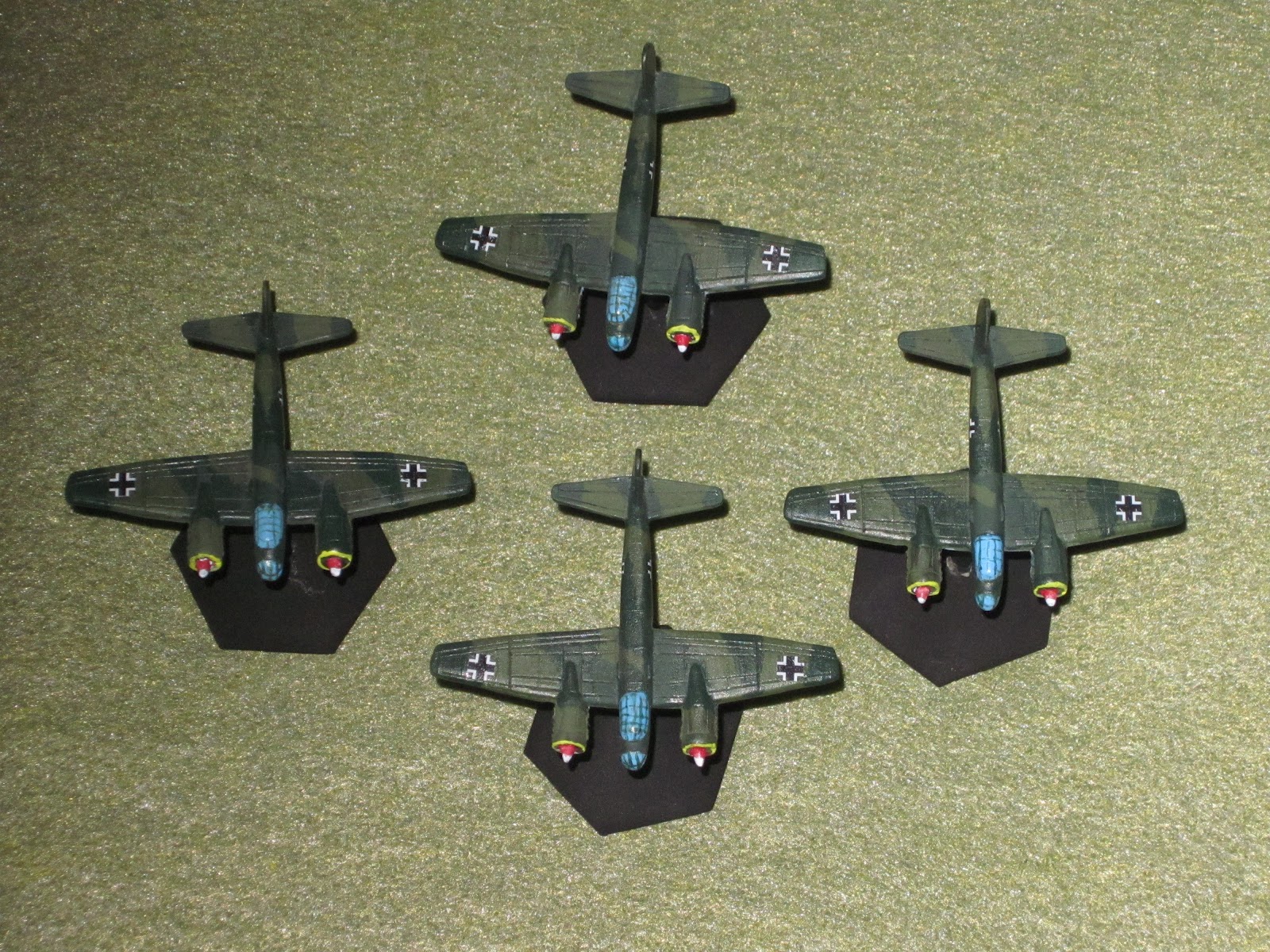
Well has promised in a previous posting I have added the decals to my 1/285th scale Ju.88s last night and here they are in all their glory.


When I painted these last year I fell into the trap of going too dark with my shades.  In addition the over spray with a rattle can of matt clear seemed to reduce the contrast between the olive green and dark green further still.


The Ju.88s was originally conceived as a ground support dive bomber.  The "maid for all work" has it became known because of the huge variety of roles they were asked to  perform while in service with the Luftwaffe.  These ranged from medium bomber to air defence night fighter. However even by 1940 when it was deployed in the Battle of Britain it was considered under powered and vulnerable to the new breed of single engine fighters which had been developed in the years leading up to the outbreak of war.


So I'll see how they fair against a couple of wings of Spitfires and Hurricanes using the Thunderbolt and Lightening rules  now they are all marked up.